Figures checked 7 Nov 202612 figures in our registerNext review 1 Jan 2027CorrectionsReport an error
Parental leave pay calculator and planner
Statutory leave pay is far below most salaries, and it changes week by week. See your income gap free below. The planner maps both parents’ leave week by week, with employer top-ups, and gives you a savings target. Editions for the US (every state with paid family leave), the UK, Australia, Ireland and Canada.
Free: how big is my income gap on leave?
| Over your leave | Amount |
|---|---|
| Calculating… | |
Cite this table
Source: DecisionsCalc, "Parental Leave Pay Calculator & Planner: US, UK, Canada, Australia, Ireland", https://decisionscalc.com/parental-leave-planner/. Free to reuse under CC BY 4.0 with this credit.
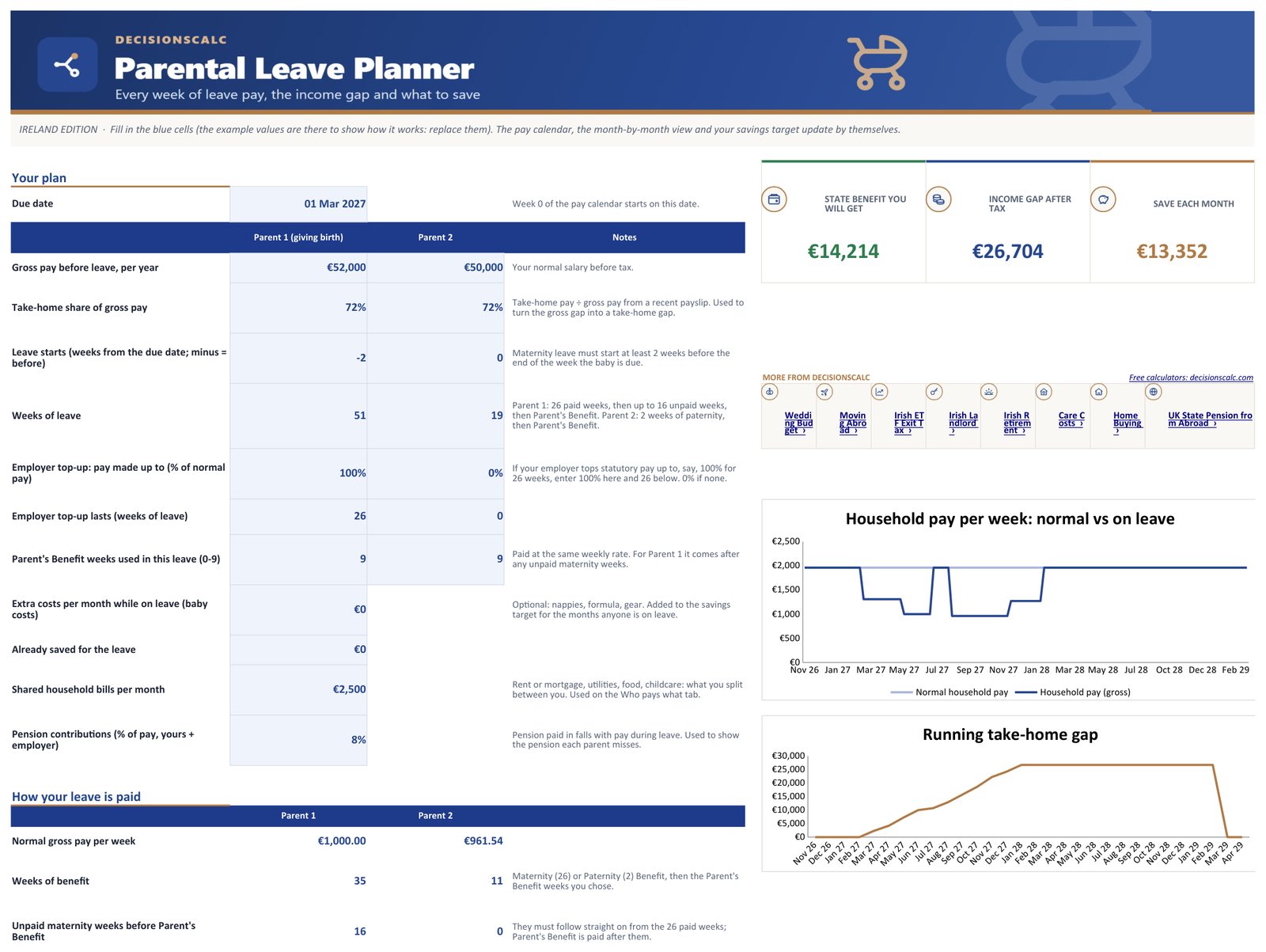
Ireland: the mother gets 26 weeks of Maternity Benefit and the other parent 2 weeks of Paternity Benefit. Each parent can also get 9 weeks of Parent’s Benefit in the child’s first 2 years. All three need enough PRSI contributions, and pay €309 a week from January 2027 (Budget 2027). For the mother, up to 16 weeks of unpaid maternity leave follow straight on from the 26 paid weeks; Parent’s Benefit comes after them. Some employers that pay you during leave ask for the benefit to be paid to them: if yours does, enter the total share of your pay it guarantees as the top-up. The planner also covers unpaid parental leave and both parents together.
Before tax. One parent, steady pay. Ireland uses the January 2027 rate (Budget 2027). US states use the latest published rates: the 2027 figure where the state has published one (Massachusetts, New York, Washington), otherwise 2026; California uses EDD’s 2026 chart until EDD publishes 2027. The planner adds the second parent, sharing rules, each week’s dated rate and the take-home gap.
The planner: both parents, every week
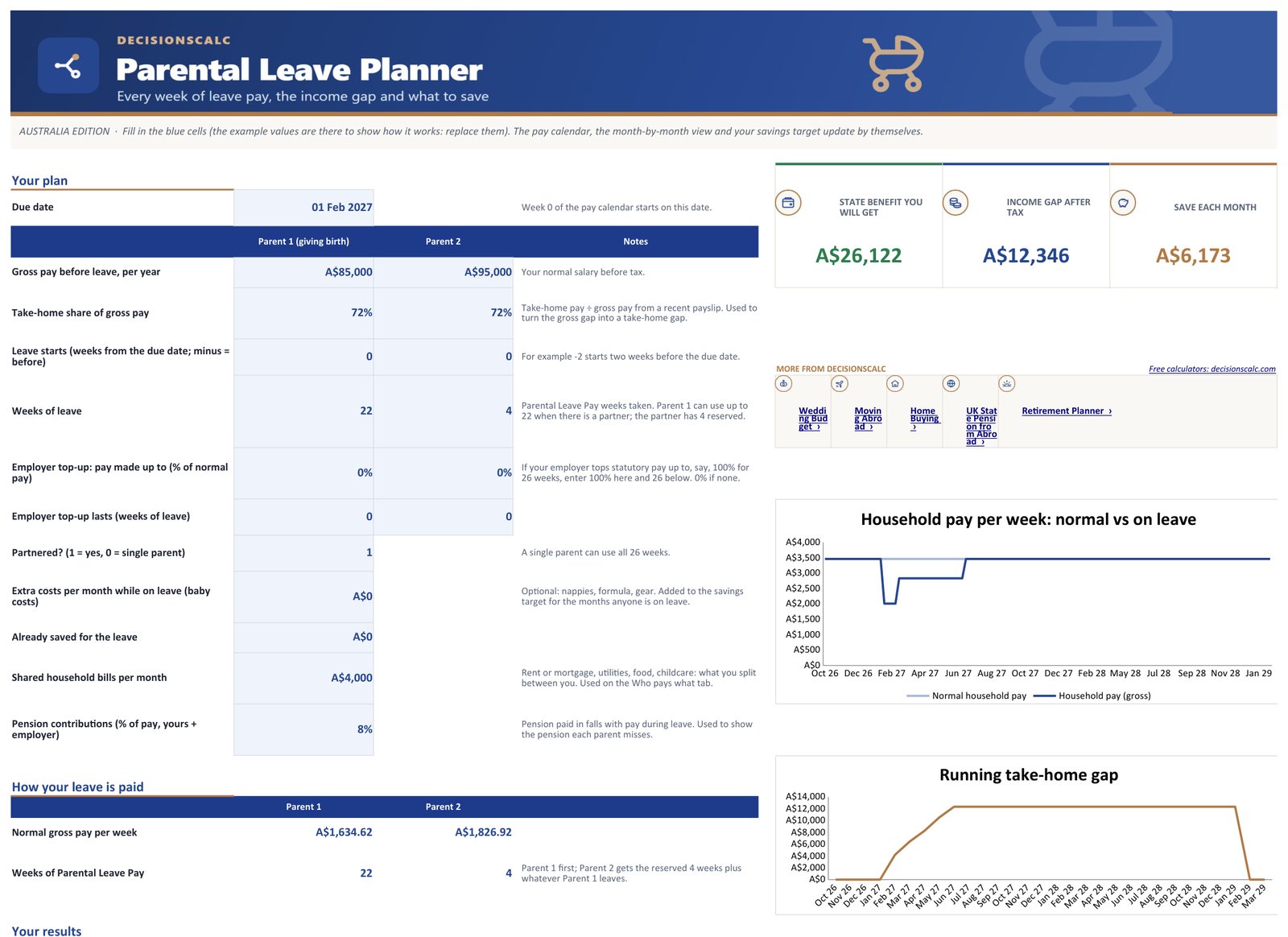
- Start here. Due date, both parents’ pay, when each one’s leave starts and how long it lasts, employer top-ups. Out come the income gap before and after tax, a savings target, how much to save each month until leave starts, and the toughest month.
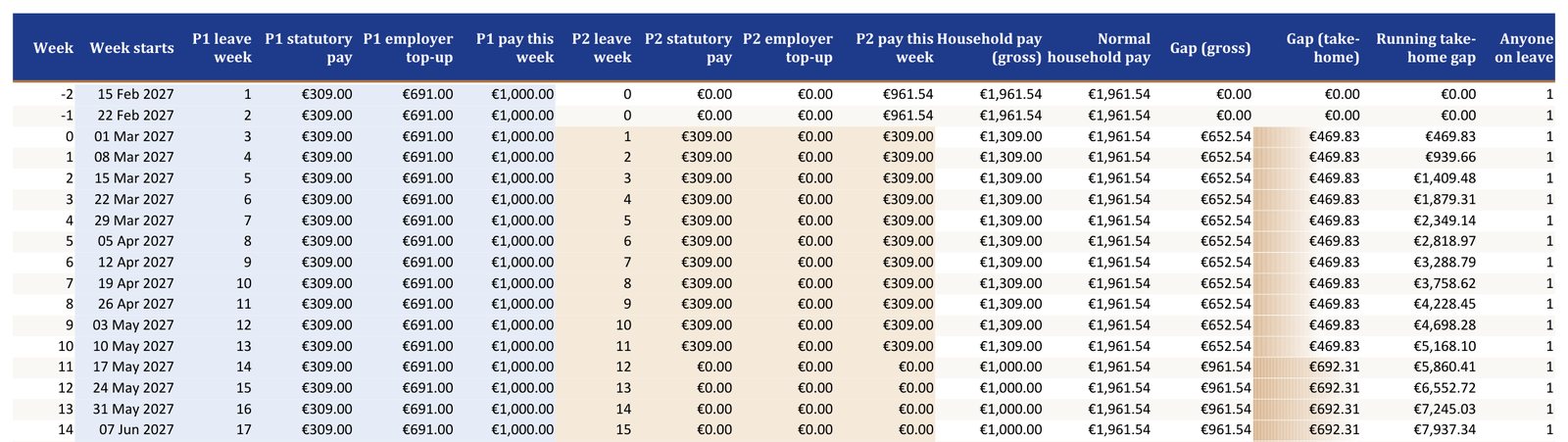
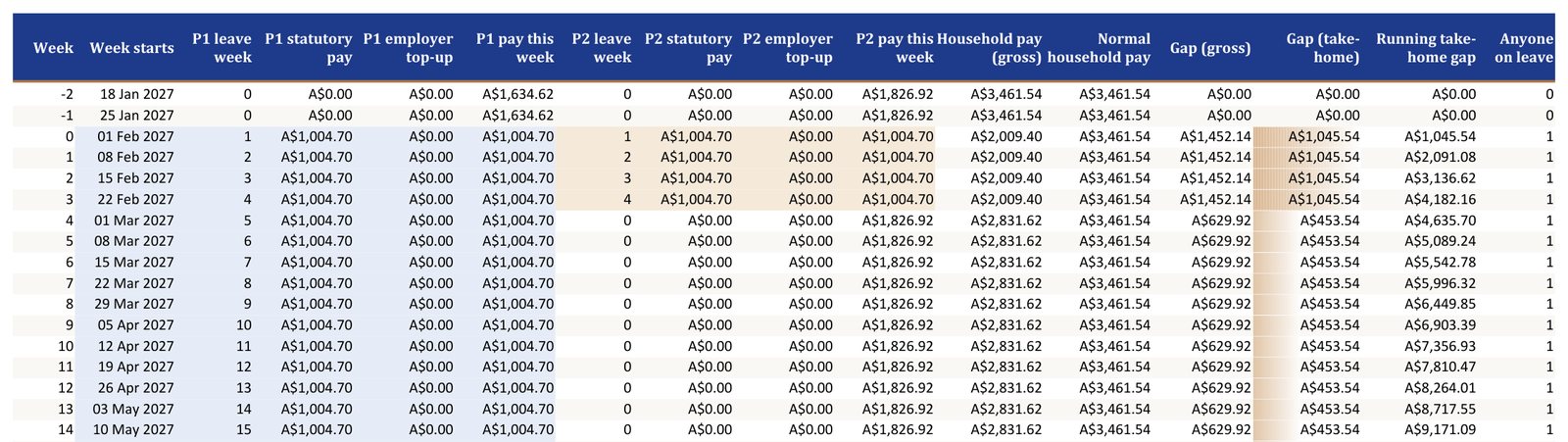
- Pay calendar. 121 weeks, from 16 weeks before the due date to the child’s second birthday: each parent’s statutory pay, top-up and pay that week, against normal household pay.
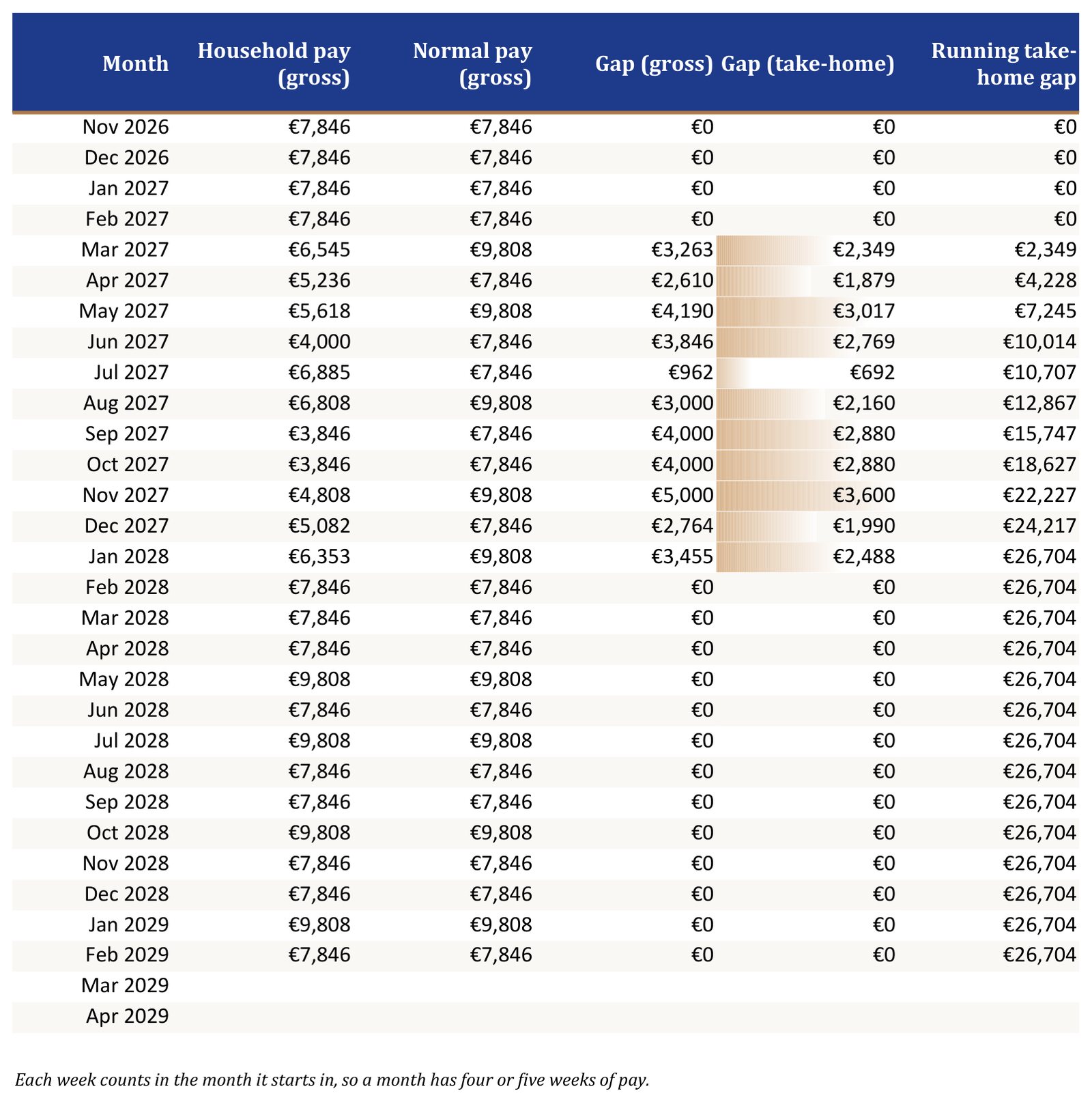
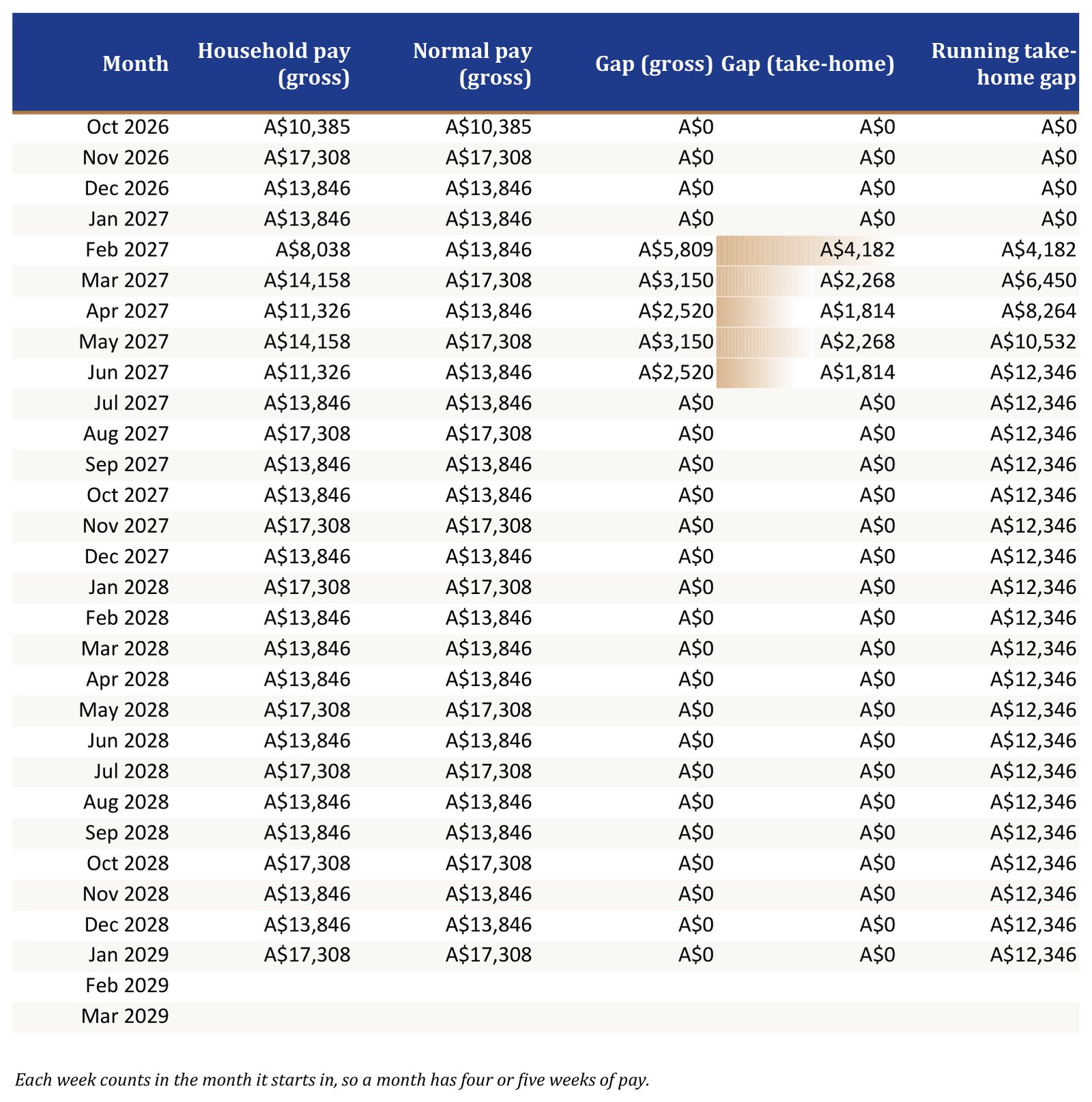
- Month by month. The same, by calendar month, so you can see which months are tight.
- Country rules built in. UK: SMP, Paternity Pay and Shared Parental Pay from the unused SMP weeks. Australia: the 26-week family allowance with the partner’s 4 reserved weeks, at each financial year’s rate. Ireland: Maternity, Paternity and Parent’s Benefit (if you have enough PRSI contributions), with the January 2027 increase. Canada: EI standard or extended, the waiting week and sharing limits, or Quebec QPIP basic or special. US: each parent's state (California, Colorado, Connecticut, DC, Delaware, Maine, Massachusetts, Minnesota, New Jersey, New York, Oregon, Rhode Island, Washington), with waiting weeks, pregnancy and recovery weeks, bonding weeks and each state's limits; FMLA-only states for employer leave.
- Rates. Every figure with the official page it was read on and the date. If a rate changes you change one cell, and we send buyers updated files.
What the Ireland edition covers
- The 16 unpaid weeks: yes. Enter the full length of the mother’s leave (up to 42 weeks of maternity leave, plus any Parent’s Benefit and parental leave); weeks after the 26 paid ones count at €0, so the gap and the tight months include them.
- An employer top-up: yes. For each parent, the share of normal pay the employer guarantees and for how many weeks (for example full pay for 26 weeks in the public sector). Some employers ask for the benefit to be paid to them; if yours does, enter the total it guarantees.
- Paternity and Parent’s Benefit: yes. 2 weeks of Paternity Benefit and 9 weeks of Parent’s Benefit for each parent, at €309 a week from January 2027, if you have enough PRSI contributions.
- Unpaid parental leave: yes, when it follows the other leave. Each parent can take 26 weeks before the child is 12; add the weeks you take straight after maternity, paternity or Parent’s Benefit to that parent’s leave. Separate blocks years later are not in the plan.
See inside
Real pages from the Ireland edition with one family’s answers typed in: 26 weeks of Maternity Benefit, 16 unpaid weeks and Parent’s Benefit, topped up to full pay for 26 weeks; the father’s Paternity and Parent’s Benefit and 8 weeks of unpaid parental leave. Tap any page to see it full size.
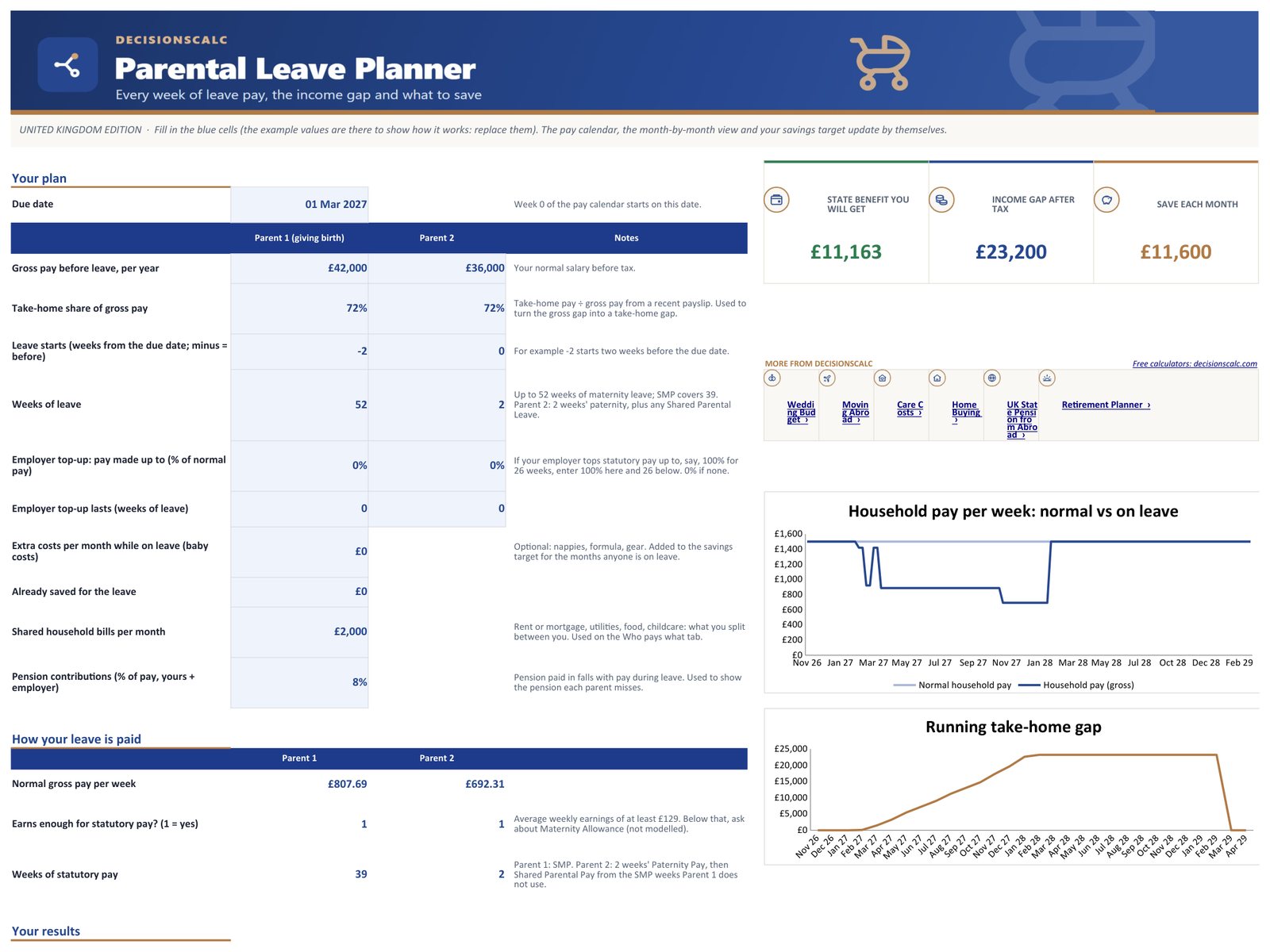
Real pages from the UK edition, with its example answers. Tap any page to see it full size.
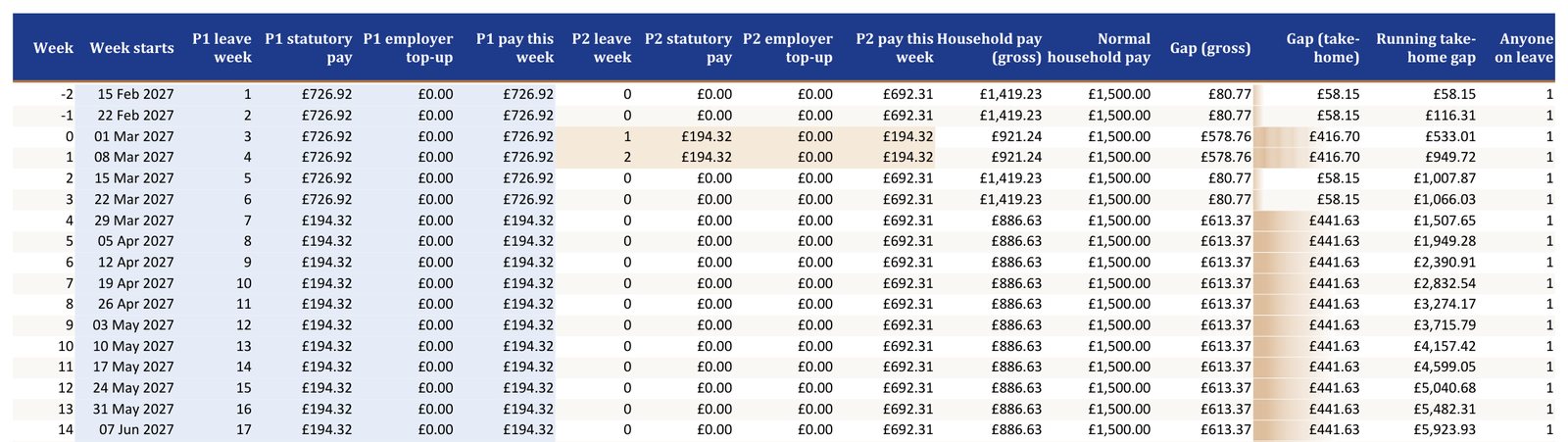
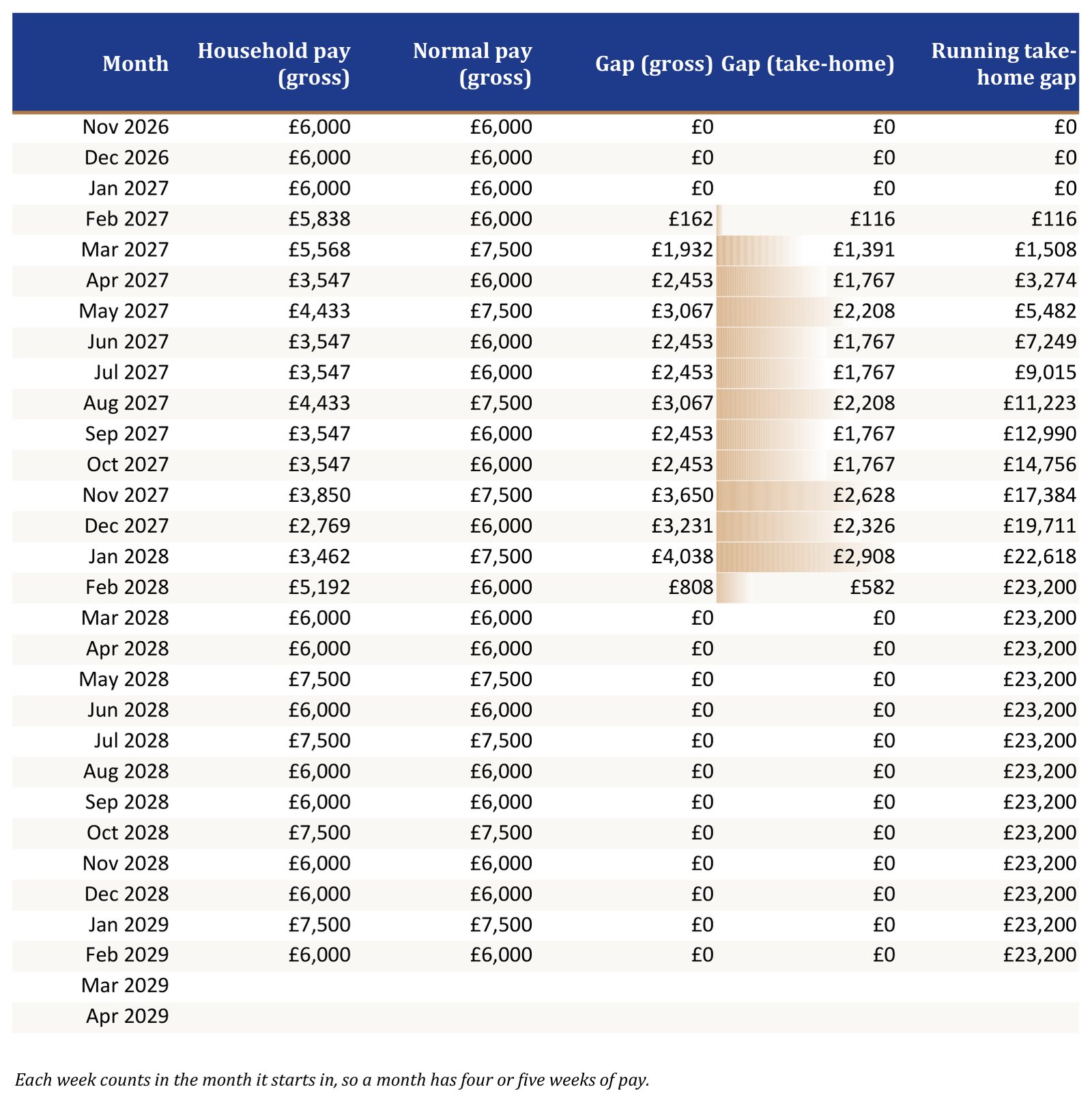
Real pages from the US edition, with its example answers. Tap any page to see it full size.
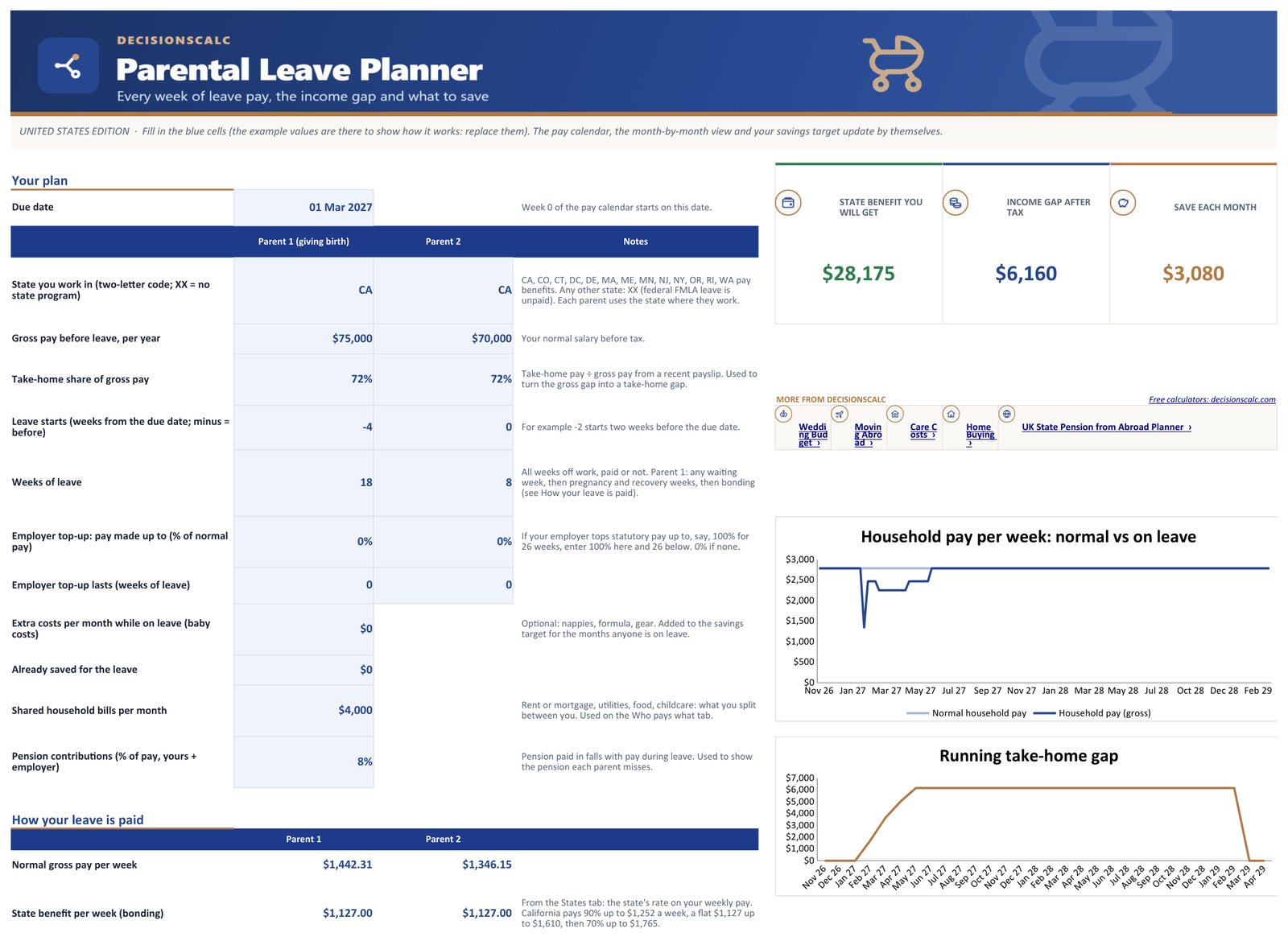
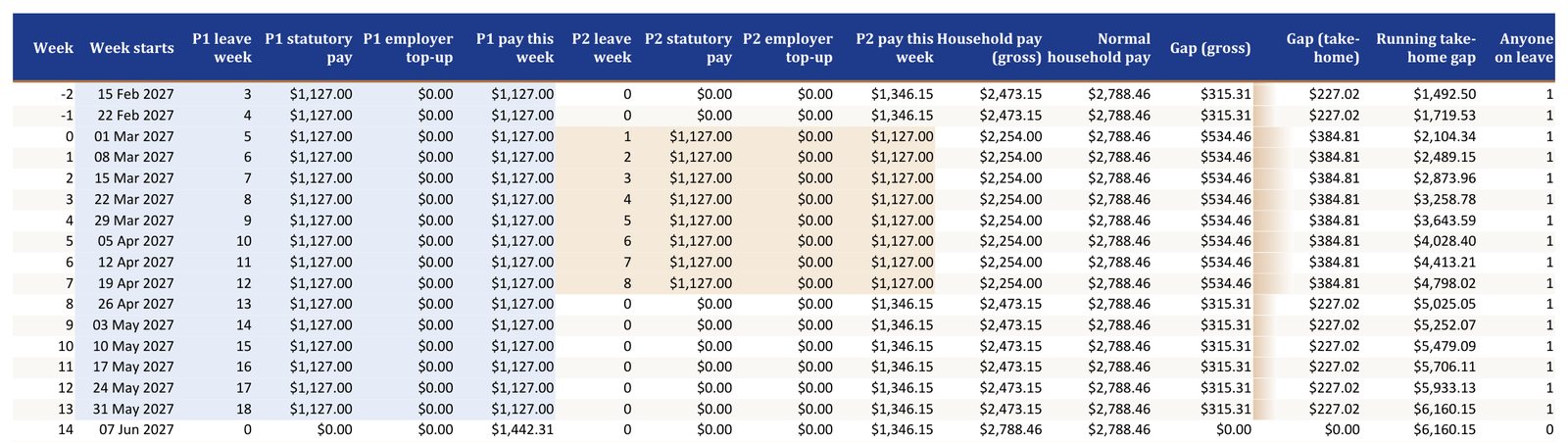
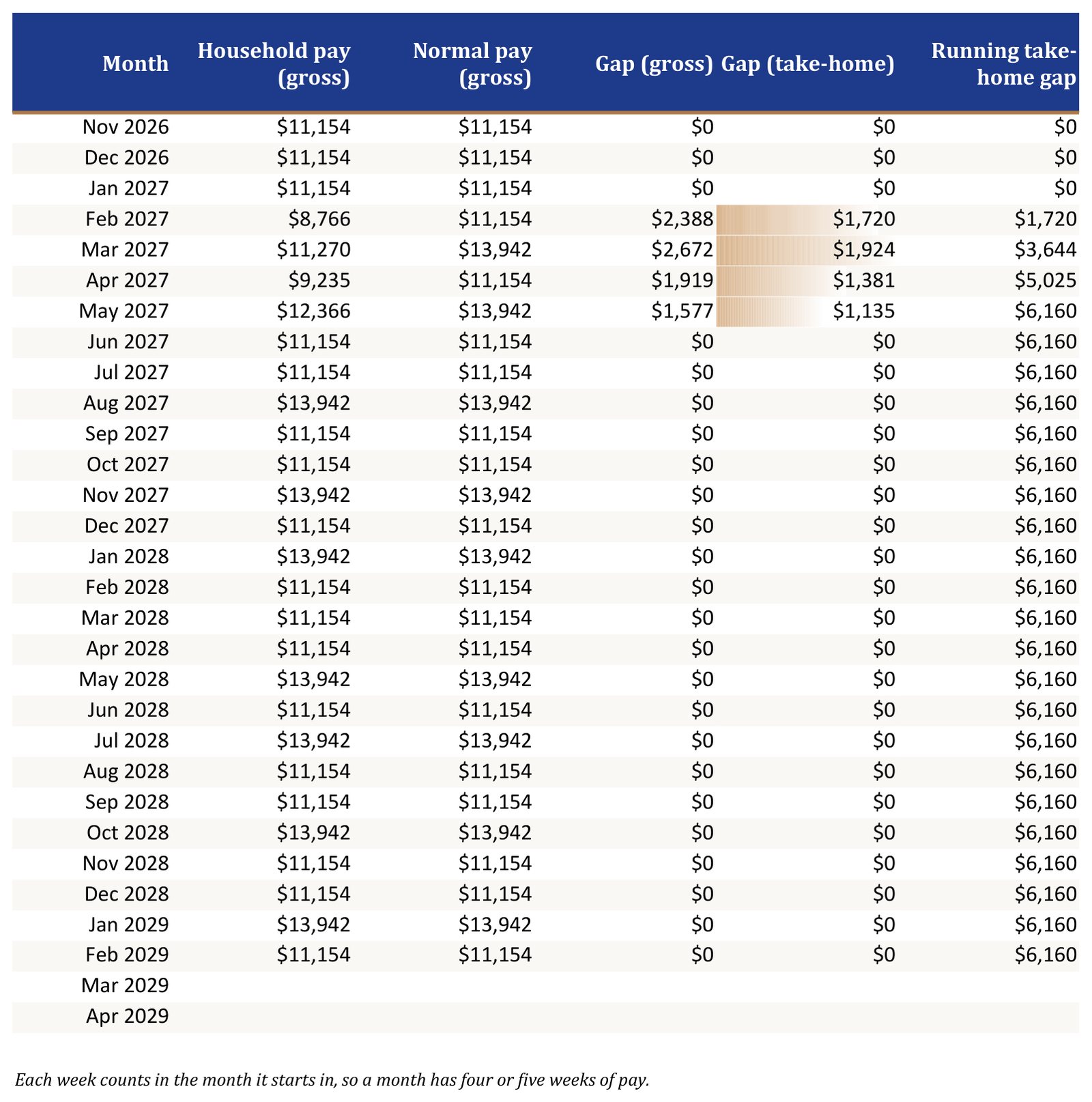
Real pages from the Canada edition, with its example answers. Tap any page to see it full size.
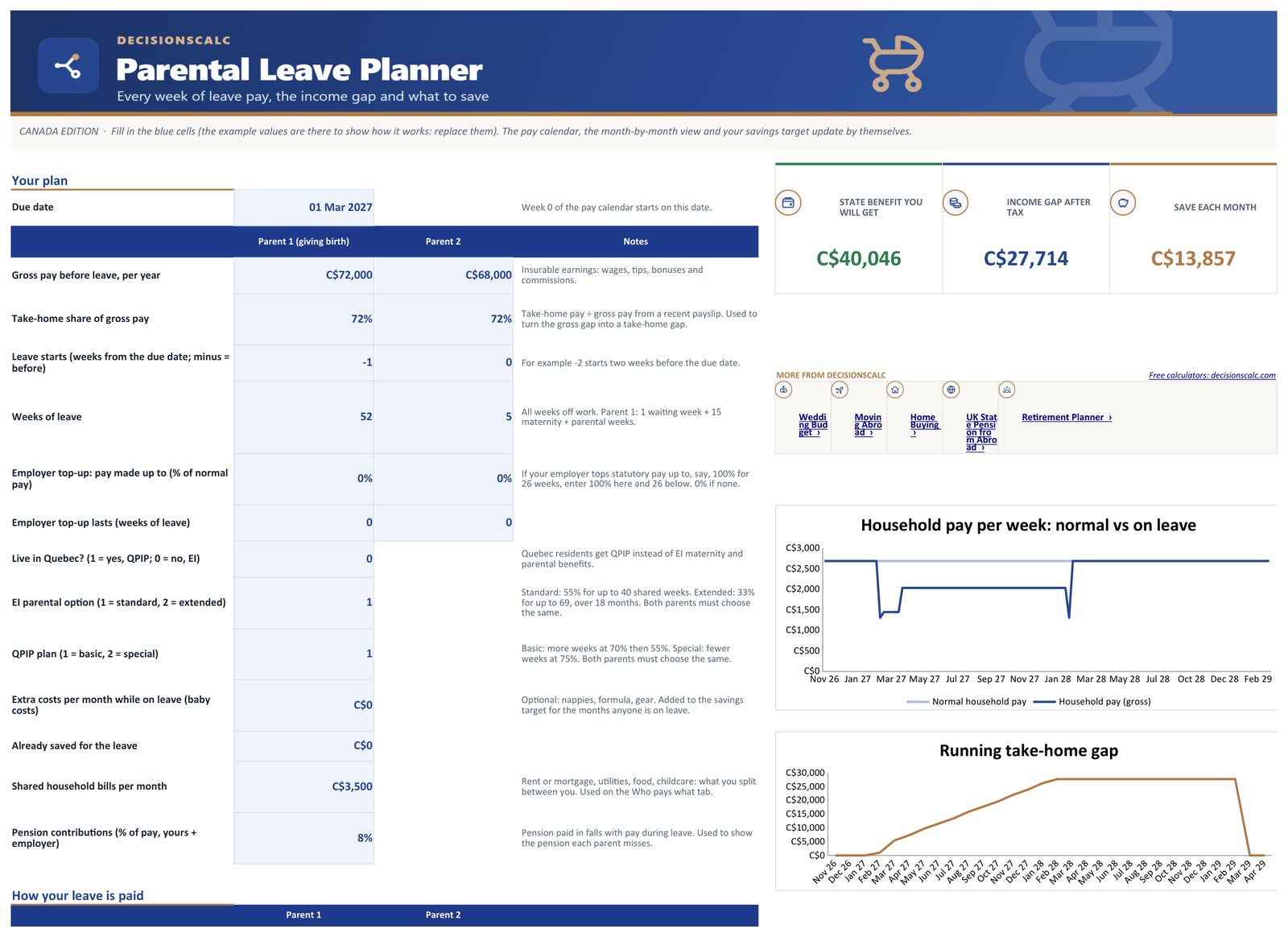
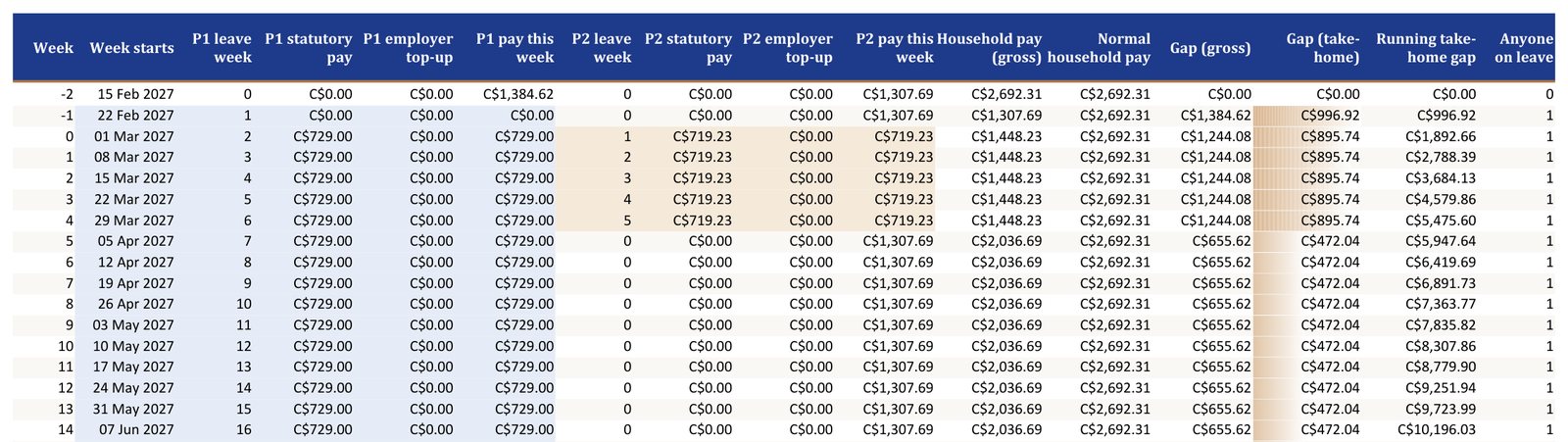
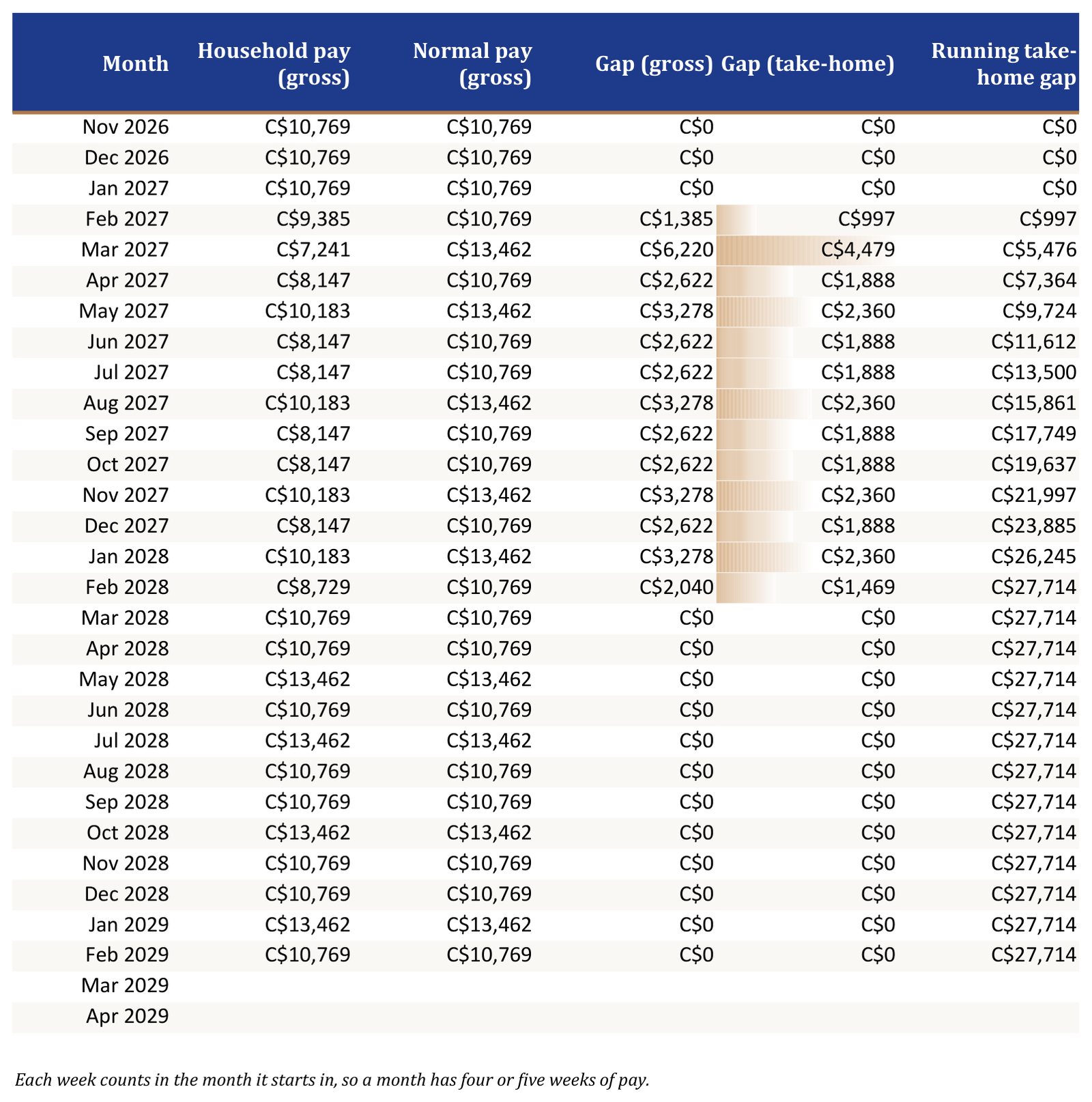
Real pages from the Australia edition, with its example answers. Tap any page to see it full size.
Free calculator or the Parental Leave Planner?
| Free calculator on this page | Parental Leave Planner | |
|---|---|---|
| The headline answer in a minute | Yes | Yes |
| Every figure linked to its official source, with the date we read it | Yes | Yes |
| A file of your own to keep (Excel, Google Sheets or LibreOffice) | No | Yes |
| Change every figure and add your own lines | Your inputs only | Yes |
| Both parents’ leave week by week: state pay, employer top-ups, the household income gap and a savings target | No | Yes |
| Your figures stay on your device | Yes (nothing is stored) | Yes |
| Cost | Free | One payment, no subscription |
Cite this table
Source: DecisionsCalc, "Parental Leave Pay Calculator & Planner: US, UK, Canada, Australia, Ireland", https://decisionscalc.com/parental-leave-planner/. Free to reuse under CC BY 4.0 with this credit.
Questions
- How much is paid family leave in the US?
- There is no federal paid leave: FMLA gives 12 weeks of job-protected leave without pay. Twelve states and DC pay benefits from a state fund. Examples: California 90% (70% for higher earners) up to $1,765 a week (2026), with pregnancy disability then 8 weeks of bonding; New York 67% up to $1,287.91 for 12 weeks (2027); New Jersey 85% up to $1,119 for 12 weeks; Washington 90% up to half the state average wage and 50% above, up to $1,727 a week from 2027. Colorado, Connecticut, Delaware, DC, Maine, Massachusetts, Minnesota, Oregon and Rhode Island also pay.
- Should I use a dependent care FSA or the child care credit when childcare starts?
- The US edition has a Childcare tab for that: from 2026 the FSA limit is $7,500 and the credit pays up to 50% of $3,000 or $6,000 of care costs, but every FSA dollar shrinks the credit. The tab tries every FSA amount against the 2026 federal tax tables, payroll tax and your state rate, and shows the one that saves the most. The same answer is free on our FSA vs child care credit calculator.
- How much is Statutory Maternity Pay in 2026?
- In the UK, SMP is 90% of your average weekly earnings for the first 6 weeks, then £194.32 a week or 90% of your earnings (whichever is lower) for the next 33 weeks: 39 paid weeks. You need average earnings of at least £129 a week.
- How much is Parental Leave Pay in Australia?
- $200.94 a day, or $1,004.70 for a 5-day week, in 2026-27. For children born or adopted from 1 July 2026 a family can get up to 130 days (26 weeks); 20 days are reserved for the partner.
- How much is Maternity Benefit in Ireland?
- €299 a week in 2026 for 26 weeks, if you have enough PRSI contributions. Budget 2027 adds €10 from January 2027 (€309). Each parent also has 9 weeks of Parent’s Benefit, and the other parent 2 weeks of Paternity Benefit, at the same rate (each if you have enough PRSI contributions).
- Does the Ireland edition cover the unpaid weeks, an employer top-up and parental leave?
- Yes. The mother’s 26 weeks of Maternity Benefit (if she has enough PRSI contributions) are followed by up to 16 weeks of unpaid maternity leave, counted at €0 a week. Each parent can enter an employer top-up (the share of normal pay guaranteed, and for how many weeks), 9 weeks of Parent’s Benefit, and the other parent 2 weeks of Paternity Benefit (each if you have enough PRSI contributions). Unpaid parental leave (26 weeks for each parent before the child is 12) is included when it is taken straight after the other leave.
- How much is EI maternity and parental pay in Canada?
- 55% of your average insurable weekly earnings up to $729 a week (2026), for 15 weeks of maternity and up to 40 shared weeks of standard parental benefits (35 for one parent). Extended parental is 33% up to $437 a week for up to 69 shared weeks. Quebec has its own plan, QPIP, at 70%, 55% or 75% of earnings up to $103,000.
- Does it work in Google Sheets?
- Yes. Upload the file to Google Drive and open it with Google Sheets. It also works in Excel (Windows and Mac) and LibreOffice. Apple Numbers can open it, but we have not tested every feature there, and Numbers does not keep drop-down lists. Standard formulas only, no macros.
- Is this advice?
- No. It is a budgeting tool built on the official published rules. The agency that pays the benefit decides your entitlement (qualifying conditions such as earnings, hours or contributions apply in every country).
- What if it isn't right for me?
- Ask for a refund within 14 days and you get your money back, even after downloading. See the refund policy.
Rules read on 3 November 2026 on gov.uk, Services Australia, Citizens Information (read 25 Nov 2026), canada.ca, Québec.ca and each US state's paid leave agency (sources in the workbook, for example California EDD and New York PFL). Guides: EI maternity and parental leave, leave by province, cost of a baby in Australia, first-year baby costs by country, FMLA and state paid leave, the true cost of a baby in the US.
Thank you!
Payment received. We're confirming it with Paddle, which usually takes a few seconds.
Keep this page's address (bookmark it): it's your personal download link, now and for future updates. Paddle has also emailed your receipt; if you lose this link, email hello@decisionscalc.com from that address and we'll resend it.
Start on the Start here tab. Opening in Google Sheets: upload the file to Google Drive, then open it with Google Sheets. Questions: hello@decisionscalc.com.